
As the AdTech industry evolves, so does the way Google evaluates partner health. The GCPP Index (formerly the Health Score) is the definitive metric for Google Certified Publishing Partners and MCM (Multiple Customer Management) account holders. It determines your eligibility, trust level, and ability to monetize efficiently.
Below is the breakdown of the scoring system, the violations that damage it, and how to protect your revenue.
1. The GAM Health Score Dashboard
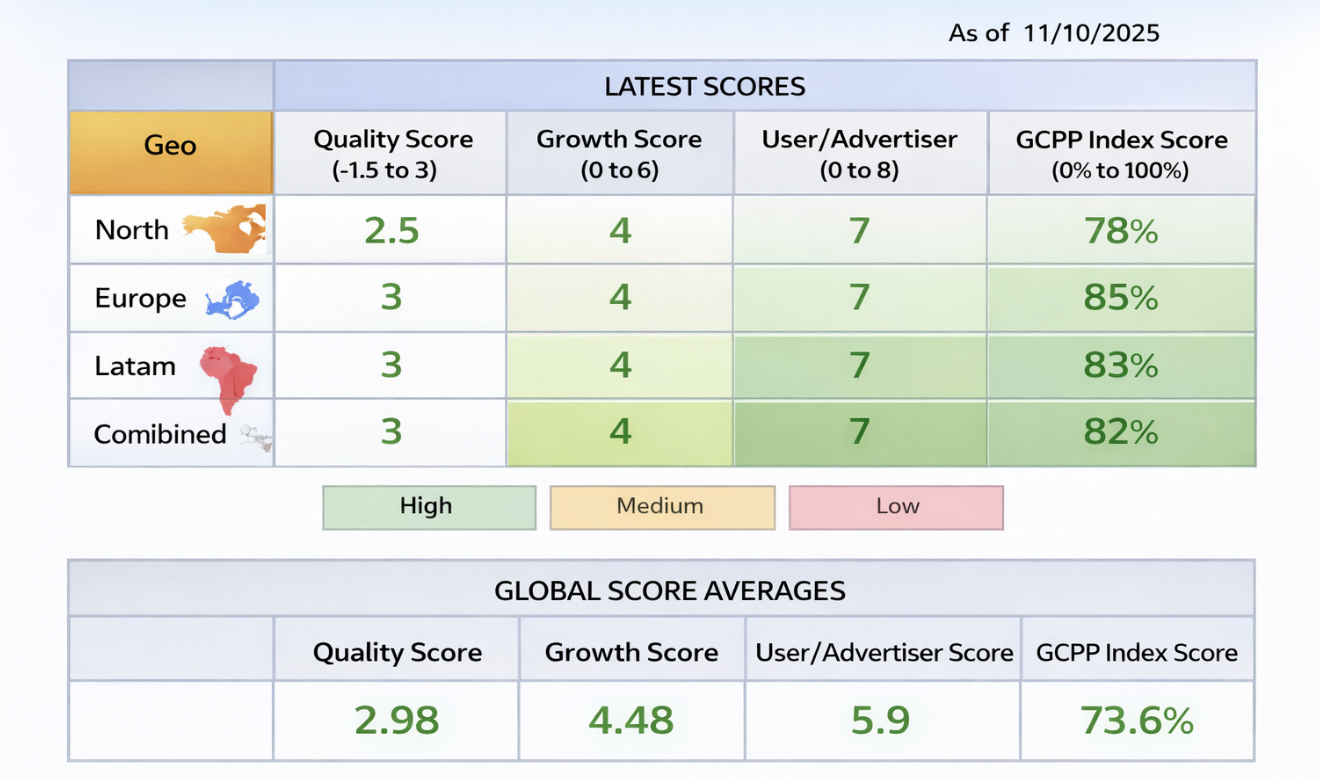
The GCPP Index assesses partners on Quality, Growth, and User/Advertiser Experience, totaling 17 Points.
The 17-Point Breakdown:
| Pillar | Max Points | Key Components | Critical Rule |
|---|---|---|---|
| Quality | 3 | Invalid Traffic %, Termination % | Score can drop to -6; must be ≥ 0 for eligibility. |
| Growth | 6 | Onboarding Rate, Retention Rate, YoY Growth | Focuses on expanding the publisher network. |
| User/Advertiser | 8 | Ads.txt, CMP Consent, Rejection Rate, Policy Violations | Focuses on compliance and inventory quality. |
| Total | 17 | Premier Partners require ≥ 80%. |
A perfect GCPP Index score is 17 Points.
This total is composed of three core pillars:
User/Advertiser Score (Max 8 Points): Measures compliance with industry standards, split into two parts (4 points each) covering metrics like Authorized Revenue Ratio (ads.txt), Certified Queries Coverage (CMP), Publisher Rejection Rate, and Policy Center Must Fix items.
2. When will an MCM account have points deducted?
Points are deducted when specific performance metrics fall below the baselines set by Google. While Google does not publish the exact mathematical formula (e.g., “0.5% IVT = -1 point”), the Quality Score is the most critical area for deductions.
You risk losing points and potentially your GCPP/MCM eligibility if your Quality Score drops below 0.
Severity: Unlike other metrics that stop at 0, the Quality Score is calculated as Invalid Traffic Score + Termination Score and can plummet to -6.
Consequence: A Quality Score below 0 renders a partner ineligible for the GCPP program and MCM privileges.
Trigger: A high ratio of ad requests impacted by Policy Center violations (Disable ad serving/Restricted ad serving) relative to total queries.
Violations That Lead to Point Deductions
A. Account Closure Reasons (Impacts Termination %)
The most severe penalty in the GCPP Index involves the Termination % Metric, which tracks the percentage of child publishers terminated for policy infractions or invalid activity. Violations in this category do not just lower a score; they can lead to complete account closure, driving the Quality Score into negative territory and rendering a partner ineligible for the program.
1. Policy Violations (Content & Behavior)
Thin and Low-Value Content: Publishers are frequently penalized for hosting content that offers minimal original value or utility to the user. This includes sites that rely heavily on scraped or replicated material, automated text generated without human curation, or pages with very few words. Google flags these as “Thin Content No Value,” and they are a primary driver for account termination because they fail to provide the substantial experience users expect.
Site Behavior & Navigation A site must offer clear and honest navigation, allowing users to easily find the content they were promised. Violations occur when sites employ misguided navigation, such as fake download buttons or redirects to irrelevant pages. Furthermore, placing ads on screens designed purely for behavioral purposes, such as alerts, log-ins, or “thank you” pages, without actual publisher content, is a significant policy breach that disrupts the user experience.
Dangerous or Illegal Content: Content that promotes illegal activity, hate speech, discrimination, or graphic violence is strictly prohibited. While often grouped under general policy violations, these are considered egregious and often lead to immediate termination rather than a simple warning. This includes “Get Rich Quick” schemes or any material that fundamentally threatens user safety or trust.
Learn more about the Content Policy Violations here.
2. Invalid Activity (IVT)
Invalid Traffic (General): This critical violation involves any clicks or impressions that do not originate from genuine user interest. The definition extends beyond simple accidents to include malicious activity, such as the use of botnets, automated clicking tools, or paying users specifically to click on ads. High levels of invalid traffic are a primary cause for the “Quality Score” to drop negatively, which can lead to immediate GCPP disqualification.
Ad Placement Violations: Poor ad implementation can inadvertently cause invalid traffic by confusing users, a practice often referred to as “encouraging accidental clicks. Common examples include placing ads under misleading headers such as “Menu” or “Resources” to trick users into thinking they are site links. Another severe violation is Ad Stacking, where multiple ads are layered on top of one another in a single slot, obscuring content and defrauding advertisers.
Site Behavior (Navigational IVT): Design choices that lead to high accidental click rates are treated as invalid activity. This often occurs when ads are placed too close to navigational links, clickable content, or interactive elements such as “Next” buttons. Even if unintentional, a layout that causes users to click ads instead of content is considered a violation of the “Ads too close to navigational links” policy.
B. Policy Center “Must Fix” Violations (Impacts User/Advertiser Score)
These violations specifically degrade the User/Advertiser Score by increasing the ratio of ad requests impacted by policy restrictions. When these issues appear in the Policy Center, they trigger “Restricted” or “Disabled” ad serving statuses that must be resolved to restore the score health.
Encouraging Accidental Clicks: This violation occurs when ad implementations are designed to trick users into interacting with ads. It involves formatting ads to mimic site content or placing them immediately next to interactive elements, such as play buttons or navigation bars. Accidental Clicks degrade the user experience and are flagged heavily in the Policy Center, requiring immediate layout changes to resolve.
Google-Served Ads on Non-Content Screens: Publishers cannot monetize screens that do not offer value. Placing Google-served ads on “Thank You,” “Login,” “Exit,” or “Error” pages is a direct violation of the “Google-served ads on screens without publisher-content” policy. The primary focus of a monetized page must be the content itself; if there is no content, no ads should be served.
Better Ad Standards Violations: Compliance with the Coalition for Better Ads is mandatory. Violations here include using intrusive ad formats that frustrate users, such as large sticky ads that cover more than 30% of the screen or auto-playing video ads with sound. These formats drive users to install ad blockers and are penalized to protect the overall ecosystem.
Thin Content / Webmaster Guidelines: Beyond just “low value,” this category targets sites that lack Expertise, Experience, Authoritativeness, and Trustworthiness (E-E-A-T). Sites that fail to demonstrate clear authorship, credentials, or specialized knowledge, or those that lack original content, are flagged for “Lack of Expertise” or “Thin Content. This indicates to advertisers that the inventory may be of low quality, which can negatively impact the User/Advertiser score.
The Solution: Protect Your Score with Ad Policy Grader
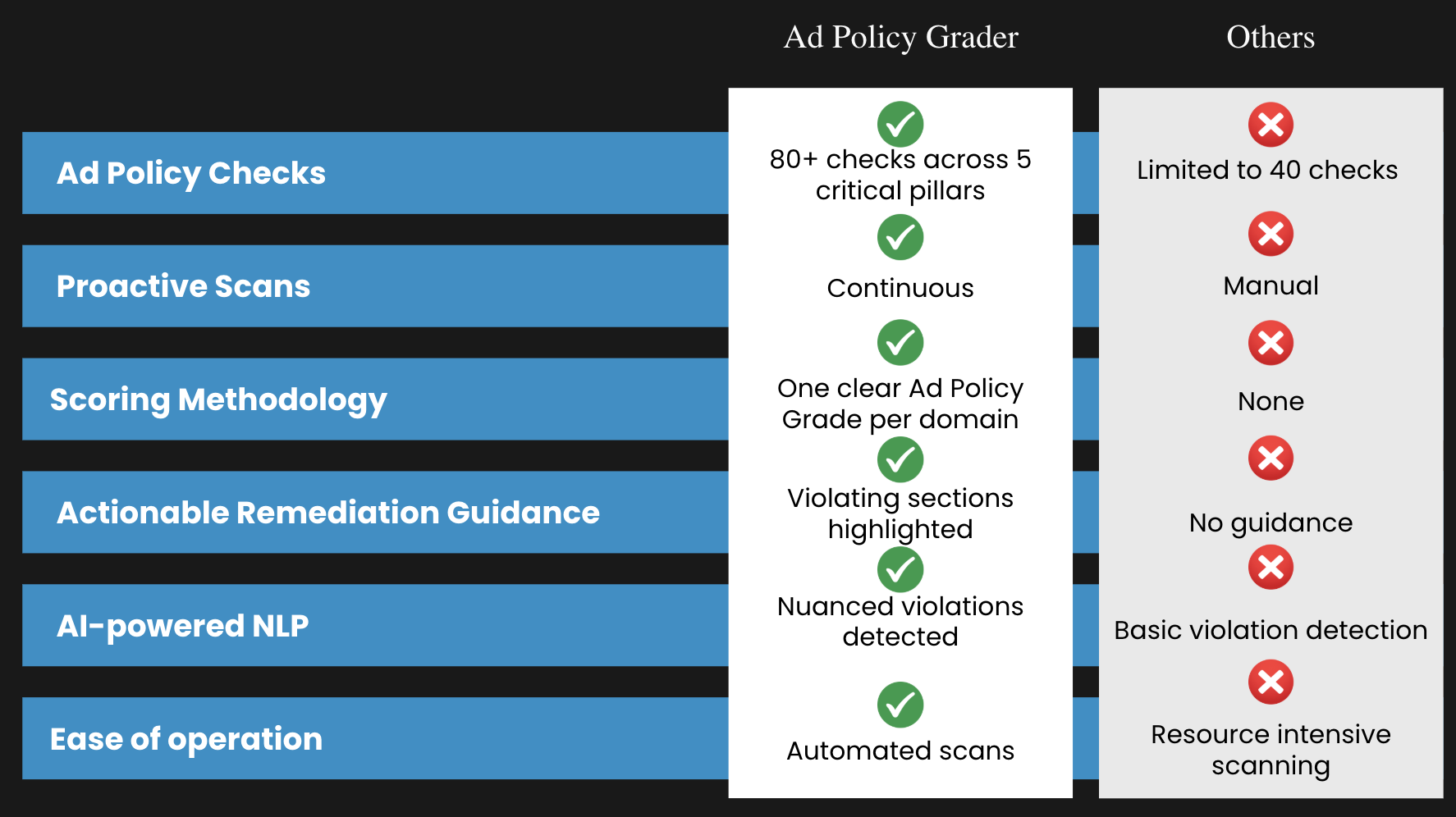
Waiting for Google to flag a violation often means the damage is already done, revenue is lost, and your Health Score takes a hit. MonetizeMore’s Traffic Cop Ad Policy Grader is designed to catch these issues before Google does.
Why use Ad Policy Grader?
Stop leaving your compliance to chance. While manual audits typically cover fewer than 40 checks, Ad Policy Grader runs over 80 automated tests across Ad Setup, Content, Site Behavior, Accessibility, and Privacy. This eliminates the blind spots inherent in human review, giving you double the coverage and complete confidence.
Financial Protection: The price of a single oversight is steep. A missed violation doesn’t just risk a warning; it can strip you of anywhere from $1,000 to $50,000 in lost revenue and trust damage. Proactive scanning acts as your revenue insurance, stopping policy strikes before they impact your bottom line.
Actionable Data: Generic tools leave you guessing; we give you the answer key. Instead of vague warnings, Ad Policy Grader pinpoints the exact location of every violation, whether it’s a “Hidden Ad Unit” or “Ads too close to navigation,” and provides clear, step-by-step remediation guidance so you can fix issues instantly.
On-Demand & Auto Scans: Compliance shouldn’t be a quarterly panic; it should be a constant standard. Run an instant diagnostic on any domain the moment you need it, or enable monthly auto-scans to catch emerging threats automatically. This “always-on” approach ensures you receive alerts long before Google enforcement kicks in.
Clear Scoring: Eliminated the ambiguity of compliance reports with a definitive 0-100 Ad Policy Score for every domain. This clear grading system gives you an instant risk assessment, allowing you to make immediate “Go/No-Go” decisions.
Specific Detection: Go beyond basic checks and catch the invisible threats that human reviewers often miss. Our AI-driven engine is trained to detect complex, nuanced violations like Ad Stacking, Thin Content, and Privacy Policy gaps, ensuring your setup is bulletproof.
Don’t gamble with your GCPP status. Protect your GCPP Index score and your revenue. Contact us here to get access to the Ad Policy Grader.
source https://www.monetizemore.com/blog/google-ad-manager-health-score/



![Best Mobile Ad Sizes to implement in 2026 [Don’t miss out]](https://lh3.googleusercontent.com/blogger_img_proxy/AEn0k_usVrOeUx5oSX0rzZX_tfHoxXDcGsOv7k-CVwru2QpU8VnV5dnr8x6NsEV550vvmTAkRADt_tQuTBSVR7_ewuJWRwg5aqa7OMIDM-86RIzFprsjI-ofrg=w680)
![Ads with Fallacies: Avoiding the Pitfalls [10 examples included]](https://lh3.googleusercontent.com/blogger_img_proxy/AEn0k_vFKGXwDWhlNZfQWfZHSEXBfcSC29oSDt3DX4EC0F5v92pvjD20IuZ3HvlmnhoJ62XxBuKHuSADcOc_gwSdkVg8BdbYZhcB5HtcZLQOjaqo5IrhDChbWKi5ZstFmZ_4KoTaddeB5dNzNWP5qWzXi13Xn0IfKW4=w680)


0 Comments