
For over a decade, the mobile ecosystem has been a walled garden. Developers grew accustomed to the “30% tax” as an inevitable cost of doing business. But in 2026, the walls aren’t just cracking, they’re being dismantled market by market.
Driven by the landmark Epic v. Google ruling and sweeping legislative shifts like the EU’s Digital Markets Act (DMA) and Japan’s Mobile Software Competition Act (MSCA), out-of-app monetization is no longer a grey area experiment. It is a core strategic pillar for high-growth publishers.
The Global Regulatory Scoreboard: Where We Stand
The transition to out-of-app monetization isn’t happening at the same speed everywhere. Here is how the key battlegrounds look today:
| Market | Current Status | Key Opportunity |
| United States | Post-Epic v. Google | Google now offers reduced commissions (capped at 10–20% for many) and “link-out” capabilities for alternative billing. |
| European Union | DMA Fully Active | Apple’s “Communication & Promotion” entitlement allows linking to external stores/web with a sunsetting Core Technology Fee (CTF) in favor of the CTC. |
| Japan | MSCA Compliance | New rules allow third-party payment systems and alternative app stores; developers can offer lower prices on their own sites. |
| Brazil | Emerging Regulatory | Increasing pressure for open billing systems to match international standards, particularly for cross-border gaming transactions. |
The Math of Moving Out: RPMs and eCPMs
When you move a transaction out of the app, you aren’t just bypassing a fee; you are changing your entire revenue profile.
In the traditional model, a $10.00 transaction nets the developer $7.00. In the out-of-app model (Web-to-App), even with a 5–15% “platform fee” and 2–3% payment processing, the developer nets $8.20–$9.30.
2026 Monetization Benchmarks
While in-app advertising (IAA) remains vital, out-of-app “web shops” are driving higher RPMs (Revenue Per Mille) by capturing users who would otherwise churn before making a high-friction IAP.
- Rewarded Video eCPM (iOS): $19.63 (US Average)
- Rewarded Video eCPM (Android): $16.49 (US Average)
- Web-to-App Transaction RPM: Can exceed $100.00+ in high-intent niches because it captures high-LTV users through direct CRM/Email marketing, bypassing the store discovery “noise.”
Niche Breakdown: Who Wins Where?
Gaming: The Hub-and-Spoke Model
Gaming is the biggest beneficiary of the Epic ruling. Mid-core and Hard-core games are moving toward a “Loyalty Hub” strategy. Use the app for gameplay, but drive users to a web shop for “Web-Exclusive” bundles.
Mobile games currently generate $15.00 annual revenue per user (ARPU) compared to just $3.00 for non-gaming apps. Moving even 10% of those transactions to a direct-to-consumer (DTC) web shop can increase net margins by 15–20%.
E-Commerce: Seamless Link-Outs
Shopping apps are leveraging “Link-Outs” to connect social media ads directly to web-based checkouts, bypassing the App Store altogether for the initial sale.
Native-looking ads lead to a web-view checkout, reducing the “store fatigue” where users might get distracted by competitors.
Mobile commerce represented 59% of all e-commerce sales in 2025. By utilizing alternative billing, retailers can reclaim the 15–30% “digital goods” margin on items like gift cards or digital vouchers.
Subscriptions (Health, Fitness & Productivity)
The “Subscription Economy” has grown 435% over the last decade. Utilizing Alternative Billing for long-term renewals.
Many developers now offer a “Web-Only” discount. By offering a subscription at $9.99 on the web vs. $12.99 in the app, the developer makes more profit while the user saves money.
The Challenges: Trust & Friction
It isn’t all easy money. Moving out of the app store removes the “Double-Click to Pay” convenience.
- User Retention: Global Day 30 retention averages are harsh—roughly 3.7% for iOS and 2.1% for Android.
- Friction: Every additional click in a link-out flow can see a 10–15% drop-off in conversion. Success requires high-trust payment providers (like Stripe or Razorpay) that users already recognize.
The Out-of-App Monetization Checklist
To help you strategically approach this shift, we’ve outlined a phased checklist for publishers:
Phase 1: Assessment and Strategy
- Analyze your current in-app purchase (IAP) revenue and identify high-value users.
- Review the specific regulations and opportunities in your key target markets (US, Japan, EU, Brazil, etc.).
- Define your goals for out-of-app monetization (e.g., increasing net margins, reducing dependency on app stores).
- Evaluate your technical capabilities and resources for implementing alternative billing and link-out solutions.
Phase 2: Planning and Implementation
- Design a compelling web-based “loyalty hub” or “web shop” with exclusive offers and bundles.
- Select and integrate a trusted and recognized payment processing provider.
- Implement clear and transparent messaging within your app to inform users about the web-based alternative and its benefits.
- A/B test different link-out strategies and placement options.
- Set up robust tracking and analytics to measure the performance of your out-of-app initiatives.
Phase 3: Launch and Optimization
- Gradually roll out your out-of-app monetization strategy, potentially starting with a specific region or user segment.
- Monitor key performance indicators (KPIs) like conversion rates, RPM, eCPMs, and user retention.
- Gather user feedback and continuously refine your offerings and messaging.
- Leverage CRM and email marketing to drive traffic to your web-based monetization channels.
- Stay informed about the evolving regulatory landscape and adapt your strategy as needed.
MonetizeMore provides the expertise, tools, and support you need to maximize your revenue in the era of out-of-app monetization. Our comprehensive solution helps you:
- Navigate regulatory changes: Stay ahead of the curve with expert guidance on compliance and opportunities in different markets.
- Optimize alternative billing: Implement and manage alternative payment systems seamlessly and securely.
- Maximize revenue: Unlock new monetization channels and optimize your overall revenue strategy.
- Improve user experience: Provide a frictionless and transparent monetization experience that builds user trust and loyalty.
Ready to take control of your mobile monetization strategy?
FAQ
What exactly is Out-of-App Monetization?
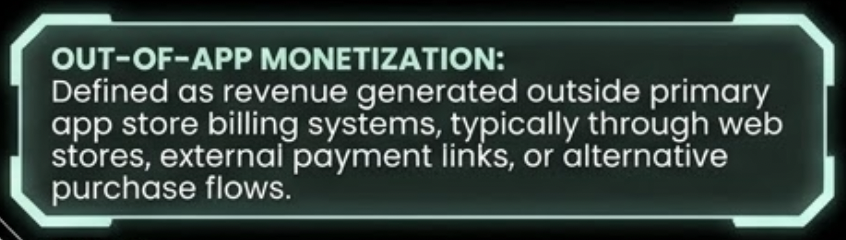
It refers to any revenue generated from your app users that does not pass through the primary Apple App Store or Google Play billing systems. This is typically achieved via Web Shops, where users buy currency or items on your website that appear in the app, or Direct Billing, where the checkout happens in a web-view within the app but uses a third-party processor like Stripe.
What are the risks of moving monetization outside the app?
The primary risk is friction. The App Store's one-tap purchase is incredibly efficient. Moving a user to a website requires them to enter credit card details or log in. You can expect a 10–15% drop-off in conversion for every extra step in the checkout process. This is why using recognized, one-tap payment methods (like Apple Pay or Google Pay on the web) is critical.
What are the current eCPM and RPM benchmarks for 2026?
For Rewarded Video eCPM (iOS) it is $19.63 while for Rewarded Video eCPM (Android) it is $16.49. Out-of-App RPM: Because these represent high-intent direct purchases, publishers focusing on web-to-app funnels often see RPMs exceeding $100.00 among their whales (top 2% of spenders).
source https://www.monetizemore.com/blog/navigating-the-out-of-app-monetization-revolution/



![Best Mobile Ad Sizes to implement in 2026 [Don’t miss out]](https://lh3.googleusercontent.com/blogger_img_proxy/AEn0k_uMLYwvMBrMVMHdxxOGRnuYCwWVb9HqZABAq22A_SiOJ8YlGaXSD-6JxG9-MmToLQUJX2obIWQFRyW4TezkIV2AQLP8SLp6CavGbDhv8D5v3ZGjLA=w72-h72-n-k-no-nu)

![Best Mobile Ad Sizes to implement in 2026 [Don’t miss out]](https://lh3.googleusercontent.com/blogger_img_proxy/AEn0k_t7h5smmoVlphdKXd4U5zGzZHBLucz5S8-I6Qfj-F0t0asen1_imBmFbfpfNdXdY9lo1bxzajPxsreQNBbqBTI0B9CmwD06kSFycDi7mINf82ndiSYFdg=w680)
![Ads with Fallacies: Avoiding the Pitfalls [10 examples included]](https://lh3.googleusercontent.com/blogger_img_proxy/AEn0k_s44sPTnoID22jUVZLZuzFUz5gNX6kZsanmjyPfJT9ki_P-fFHvNuG1opyDl3u2aiRHeGmYSBMD07cmGmZEnTV2Nrg9g0a794-DoX3K8sW-guBtpkJ_3kfPIdu6FhGpVX2YuFSZKbzBVUzvnt4Q62ra-pZA6HI=w680)


0 Comments